
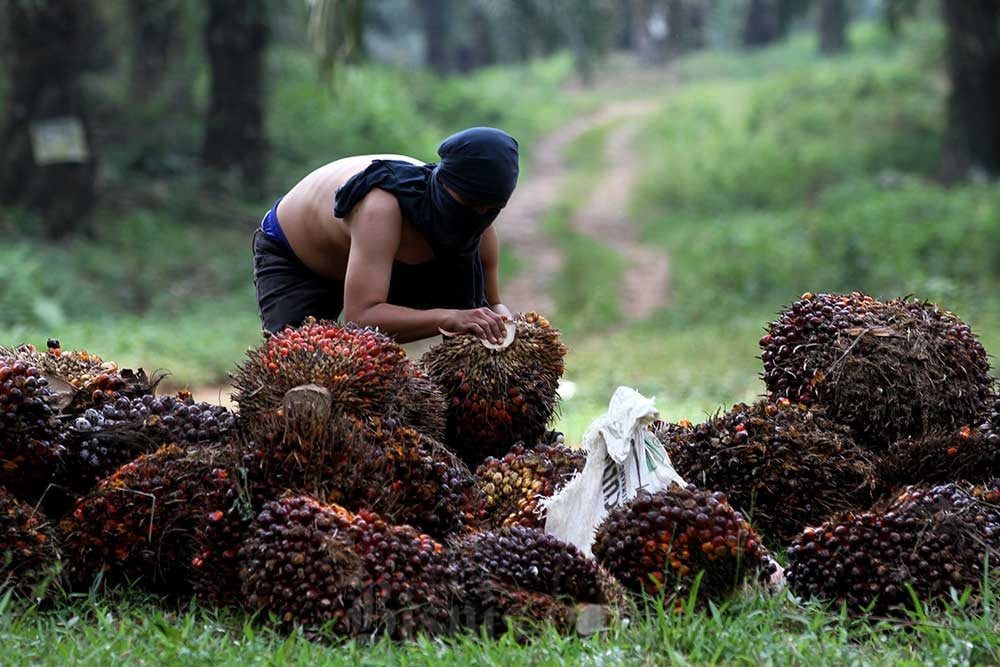
The Indonesian government has issued Government Regulation (PP) No. 45 of 2025, amending PP No. 24 of 2021 on the procedures for imposing administrative sanctions in the forestry sector. The regulation sets an administrative fine of IDR 25 million per hectare per year for oil palm plantations located inside designated forest areas (kawasan hutan) without a permit. It has raised serious concern among palm oil businesses and growers across the country.
How the fine is calculated
Under PP 45/2025, the administrative fine is calculated with the formula D = L x J x TD, where D is the administrative fine, L is the area of the violation inside the forest area (in hectares), J is the duration of the violation, and TD is the fine rate, set at IDR 25 million.
As an illustration: a party that has controlled 100 hectares of oil palm inside a forest area since 2010 would face a fine of IDR 25 billion in 2025. The calculation is 100 hectares x 10 years (2025 minus 2010, minus a 5-year unproductive period) x IDR 25 million = IDR 25 billion.
Exposure of smallholders
Of particular concern is that 42% of Indonesia's oil palm land is held by smallholder farmers. The regulation would therefore directly affect 2.4 million smallholder households and 16.5 million workers in the oil palm plantation sector. Where land has been occupied for 20 years, the total fine could reach IDR 375 million per hectare, far above the market value of oil palm land, which ranges from only IDR 50–100 million per hectare.
Smallholder plantations are a backbone of stability for the national palm oil sector and bring wide benefits to regional economies. Farmers earn income from selling fresh fruit bunches (FFB), which in turn supports related businesses such as fertiliser and farm-equipment suppliers and stimulates local investment.
Criticism from experts
Dr. Sadino, a forestry law expert at Al-Azhar University of Indonesia, considers PP 45/2025 a serious threat to the sustainability of the national palm oil industry. In his view, the regulation was drafted with minimal public consultation and without involving key stakeholders.
"The policy paradigm has shifted from guidance to destruction, from regularisation to expropriation," Sadino said. He stressed that the fine levels are unrealistic and could lead to mass lay-offs, non-performing loans and the abandonment of plantations.
Prof. Dr. Budi Mulyanto, a professor at IPB University (Bogor Agricultural University) and head of its Palm Oil Studies Centre, warned that PP 45/2025 expands the powers of the Forest Area Enforcement Task Force (Satgas PKH), using alarming terms such as "repossession", "government coercion", "freezing of bank accounts" and even "travel bans".
A shift in legal philosophy
Muhamad Zainal Arifin, Director of the Centre for Natural Resources Law Studies and Advocacy (PUSTAKA ALAM), pointed to a fundamental shift in legal philosophy. The Job Creation Law (UU Cipta Kerja) emphasises resolving existing plantations inside forest areas through administrative fines rather than criminal penalties. PP 45/2025, however, introduces a "repossession" mechanism under which, even after the fine is paid, the land is not automatically legalised but is instead taken over by the state.
Root of the forest-area problem
According to Prof. Dr. Sudarsono Soedomo of IPB University, the forest-area problem dates back to 1967 and the enactment of Law No. 5 on the Basic Provisions of Forestry. Past mismanagement of forest areas was not caused solely by palm oil operators; it also stemmed from regional autonomy policies that allowed district heads (bupati) to issue permits while the central government did not yet have an integrated mapping system.
Wider economic implications
The palm oil industry is a mainstay of the Indonesian economy: it employs more than 18 million people, is a leading source of foreign exchange, and underpins national food and energy security. Implementation of PP 45/2025 could disrupt the investment climate and damage Indonesia's image as an investment destination.
The experts stress that, as a matter of principle, fines should be proportionate to the severity of the violation and the profit obtained, rather than a fixed amount. The Job Creation Law emphasises fines based on a percentage of profit, with the aim of improving compliance rather than shutting businesses down.
The regulation reflects a dilemma between the government's effort to bring order to forest areas and the need to sustain a palm oil industry that is vital to the national economy. A more balanced approach involving all stakeholders is needed to resolve this complex issue without sacrificing millions of smallholders and plantation workers.
Last updated:
Indonesian version: PP 45 Tahun 2025: Ancaman Denda Tinggi terhadap Industri Kelapa Sawit Indonesia